Who is this product best for?
- Home and small office routing
- Business internet edge routing
- ISP customer or branch deployments

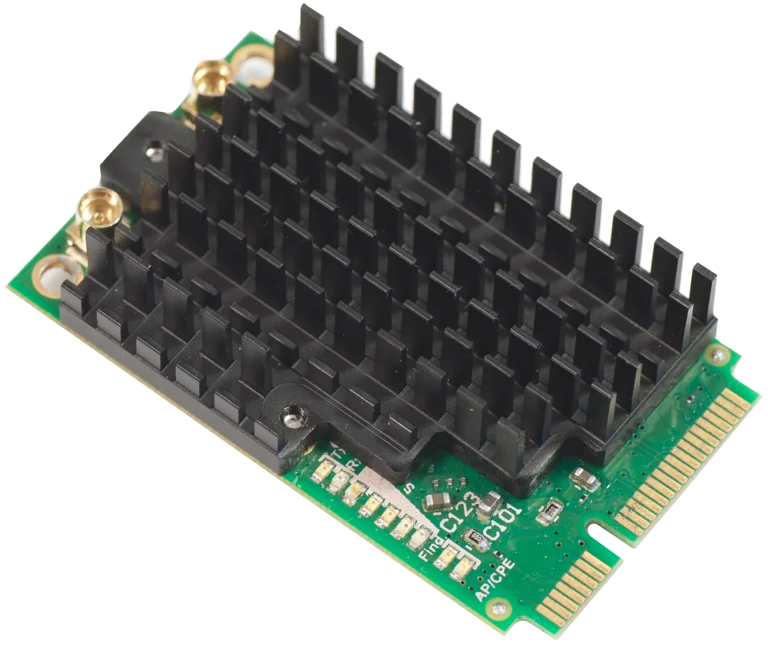
Mikrotik interfaces Price In Kenya
IN STOCKWorks with compatible MikroTik RouterOS networks and standard Ethernet networking equipment. Confirm port, power and mounting requirements before purchase.
Check the product label or manufacturer datasheet for exact input voltage, PoE support and power adapter requirements.
MikroTik wireless interface cards provide a flexible way to add, replace, or expand wireless connectivity in compatible RouterBOARD devices, embedded networking systems, and specialized wireless installations. They are particularly useful for wireless ISPs, network integrators, enterprise networks, IoT projects, long-distance wireless links, and custom RouterOS deployments.
MikroTik has produced several miniPCIe interface card families covering 2.4 GHz Wi-Fi, 5 GHz Wi-Fi, LTE/mobile broadband and LoRa connectivity. For example, MikroTik's documentation lists R11e-2HnD and R11e-2HPnD as 2.4 GHz miniPCIe cards, while its RouterOS wireless documentation also identifies models such as R11e-5HnD and R11e-5HacD for 5 GHz applications. (MikroTik Help)
For buyers in Kenya, choosing the correct interface card requires more than comparing prices. Frequency band, host-device compatibility, antenna connectors, RouterOS support, wireless generation and intended application should all be considered before purchase.
At Mikrotik Kenya, customers can source MikroTik networking products and receive assistance choosing suitable wireless interface solutions for ISP, enterprise, hotspot, point-to-point, IoT and customized networking deployments.
MikroTik Wireless Interface Cards Price in KenyaMikroTik Interface CardWireless/Network TypeInterfaceTypical ApplicationIndicative Kenya PriceR11e-2HnD2.4 GHz Wi-Fi 4miniPCIeAPs and CPEsKES 4,000 – 7,000R11e-2HPnD2.4 GHz Wi-Fi 4miniPCIeHigh-power wireless linksKES 5,000 – 8,000R11e-5HnD5 GHz Wi-Fi 4miniPCIeWireless backbone/CPEKES 5,000 – 9,000R11e-5HacD5 GHz Wi-Fi 5miniPCIeFaster 5 GHz linksKES 7,000 – 12,000R11e-LTELTEminiPCIeMobile broadbandKES 8,000 – 15,000R11e-LTE6LTE Cat 6miniPCIeFaster LTE connectivityKES 12,000 – 20,000R11e-LR8LoRa 863–870 MHzminiPCIeIoT gatewaysKES 10,000 – 18,000R11e-LR9 / LR9GLoRa 902–928 MHzminiPCIeIoT/telemetryKES 12,000 – 22,000Important: These are indicative market ranges rather than guaranteed selling prices. Wireless card prices in Kenya vary according to availability, model generation, exchange rates and whether a particular model is current or legacy. Contact Mikrotik Kenya for the current selling price before ordering.
Types of MikroTik Wireless Interface CardsThe R11e-2HnD and R11e-2HPnD are miniPCIe wireless cards designed for 2.4 GHz networking. MikroTik specifies 802.11b/g/n support for this family. (MikroTik Help)
SpecificationR11e-2HnDR11e-2HPnDFrequency Family2.4 GHz2.4 GHzWi-Fi GenerationWi-Fi 4Wi-Fi 4Standards802.11b/g/n802.11b/g/nForm FactorminiPCIeminiPCIeAntenna Connections2 × U.FL2 × MMCXChainsDual-chainDual-chainMaximum Power Consumption5 W5 WBest ApplicationGeneral wireless networkingHigher-power wireless deploymentsMikroTik's product documentation specifies up to 800 mW maximum output for the R11e-2HnD and up to 1000 mW for the R11e-2HPnD, although actual permitted output depends on configuration and local regulations. (MikroTik CDN)
They can be useful for:
Wireless access points
Custom RouterBOARD installations
Hotspot networks
Rural wireless installations
Indoor and outdoor CPE configurations
Legacy wireless infrastructure
Because 2.4 GHz generally offers good propagation but is often congested, it is important to evaluate interference before selecting it for a busy commercial environment.
2. MikroTik 5 GHz Wireless Interface CardsFor applications requiring more wireless spectrum and higher-capacity links, MikroTik has offered 5 GHz miniPCIe cards such as the R11e-5HnD and R11e-5HacD.
MikroTik's RouterOS documentation lists the R11e-5HnD with 20/40 MHz channels and the R11e-5HacD with 20/40/80 MHz support. (MikroTik Manual)
5 GHz wireless cards can be advantageous where you need:
Higher-capacity wireless links
Point-to-point networking
ISP distribution networks
Building-to-building links
Wireless backhaul
Reduced congestion compared with busy 2.4 GHz environments
MikroTik's interface-card range extends beyond conventional Wi-Fi. LTE miniPCIe cards can add cellular connectivity to compatible MikroTik devices.
MikroTik documentation identifies models including R11e-LTE6, R11e-4G, R11e-LTE and R11e-LTE-US as LTE miniPCIe cards. (MikroTik Help)
LTE CardConnectivityTypical UseR11e-LTELTEStandard mobile broadbandR11e-LTE6LTE Cat 6Higher-speed mobile broadbandR11e-4GCellular connectivityCompatible mobile deploymentsRegional LTE VariantsRegion dependentSpecialized deploymentsLTE interface cards can be considered for:
Branch-office backup internet
Rural connectivity
Mobile networking
Remote CCTV systems
ATMs and kiosks
IoT gateways
Temporary project sites
Internet failover
Compatibility with Kenyan mobile-network bands should always be confirmed for the exact card before purchase.
4. MikroTik LoRa Wireless Interface CardsMikroTik also produces miniPCIe LoRa interface cards designed for long-range, low-power IoT communication.
ModelFrequencyInterfaceTypical ApplicationR11e-LR8863–870 MHzminiPCIeLoRa IoT gatewayR11e-LR9902–928 MHzminiPCIeRegional LoRa deploymentsR11e-LR9G915 MHz familyminiPCIeLoRa + GPS applicationsThe R11e-LR8 documentation describes a miniPCIe interface supporting LoRa Class A and C, with up to 15 km quoted for rural environments when paired with MikroTik's specified antenna kit. Actual range depends heavily on terrain, interference, antenna placement and installation. (MikroTik CDN)
The newer R11e-LR9G combines LoRa connectivity with onboard GPS functionality, making it useful for applications such as smart agriculture, industrial sensor networks and mobile gateway deployments. (MikroTik CDN)
MikroTik Wireless Interface Card ComparisonFeatureR11e-2HPnDR11e-5HnDR11e-5HacDR11e-LTE6R11e-LR8TechnologyWi-FiWi-FiWi-FiLTELoRaBand2.4 GHz5 GHz5 GHzCellularSub-GHzForm FactorminiPCIeminiPCIeminiPCIeminiPCIeminiPCIeMain PurposeHigh-power WLAN5 GHz WLANFaster 5 GHz WLANMobile broadbandIoTSuitable for ISP UseYesYesYesYesSpecializedIoT ApplicationLimitedLimitedLimitedYesExcellentExternal Antenna SupportYesYesYesModel dependentYesBest DeploymentAP/CPEBackhaul/CPEHigh-speed wirelessLTE connectivityLoRa gatewayMikroTik RB14e and Wireless Card ExpansionFor compatible computer-based installations, MikroTik produced the RB14e adapter, which allows up to four miniPCIe wireless cards to be installed through a PCIe x1 interface.
RB14e FeatureSpecificationHost InterfacePCIe x1miniPCIe Slots4Intended ApplicationWireless cardsBracketsNormal and low-profileExpansion PurposeMultiple wireless interfacesMikroTik also documented the RB14eU variant for wireless and 3G cards, including SIM slots and USB connectivity required by compatible cellular cards. (MikroTik CDN)
This type of solution can be particularly useful for specialized network appliances where several independent wireless interfaces are required.
What to Consider Before Buying a MikroTik Wireless Interface CardBuying FactorWhy It MattersFrequencyDetermines wireless network compatibilityHost DeviceMust physically and electrically support the cardminiPCIe SupportRequired for R11e cardsAntenna ConnectorU.FL/MMCX and antenna system must matchWireless StandardAffects speed and compatibilityRouterOS VersionDetermines software supportFrequency RegulationsDeployment must comply with local requirementsCard AvailabilitySome older cards may be difficult to sourceLTE BandsCritical for cellular deploymentsIntended ApplicationWi-Fi, LTE and LoRa cards serve different purposesMikroTik specifically advises users to keep compatible host devices on an appropriate RouterOS version and to comply with local rules covering frequency channels, output power and related wireless requirements. (MikroTik Help)
Applications of MikroTik Wireless Interface Cards in KenyaWISPs can use compatible interface cards to build specialized access points, CPE devices and wireless backbone systems.
Businesses can deploy wireless interface cards where customized wireless infrastructure or additional radios are required.
5 GHz cards can be paired with appropriate antennas to create links between buildings, offices and remote facilities.
LTE interface cards can provide cellular failover where fixed internet connectivity is unavailable or interrupted.
LoRa interface cards can support smart agriculture, telemetry, industrial monitoring and other long-range sensor networks.
Compatible wireless or LTE cards can help provide connectivity for remote CCTV and monitoring infrastructure.
Why Buy MikroTik Wireless Interface Cards from Mikrotik Kenya?Choosing genuine MikroTik hardware is particularly important with internal wireless cards because compatibility, radio performance and RouterOS support directly affect network reliability.
Not every wireless card works with every MikroTik device. Mikrotik Kenya can help buyers identify an appropriate interface based on the RouterBOARD model, miniPCIe slot, antenna system, required frequency and intended application.
Customers can obtain assistance with areas such as:
RouterOS configuration
Wireless interface setup
ISP networking
Point-to-point links
LTE connectivity
Wireless troubleshooting
Antenna selection
IoT network deployment
Whether you are upgrading one compatible RouterBOARD or designing wireless infrastructure for an ISP, enterprise, school, hotel, farm or remote site, the correct interface card can help create a more flexible network.
Frequently Asked Questions About MikroTik Wireless Interface Cards in KenyaA MikroTik wireless interface card is an internal networking module that adds a specific type of wireless connectivity to compatible networking hardware. Depending on the model, this may include 2.4 GHz Wi-Fi, 5 GHz Wi-Fi, LTE or LoRa.
Prices can range from approximately KES 4,000 to above KES 20,000, depending on the exact model, technology, availability and generation. Always request the current price for the specific model before purchasing.
The R11e-2HPnD is a high-power 2.4 GHz dual-chain miniPCIe wireless card supporting 802.11b/g/n. MikroTik specifies two MMCX connectors for this model. (MikroTik CDN)
The R11e-5HnD is a 5 GHz miniPCIe wireless card supporting 802.11a/n. It is designed for compatible MikroTik hardware and wireless networking applications. (MikroTik CDN)
The R11e-5HnD belongs to the 802.11a/n generation, while the R11e-5HacD supports 802.11ac and wider channels, making the latter better suited to higher-throughput 5 GHz applications. (MikroTik Manual)
Some compatible MikroTik devices can use miniPCIe LTE cards. MikroTik documents R11e-LTE, R11e-LTE6 and other variants for this purpose. Device, USB-line and SIM compatibility must be checked before installation. (MikroTik Help)
Yes. Depending on the card and host device, they can be used for wireless access, CPE equipment, backhaul links, LTE connectivity and specialized networking.
No. The router must provide the correct physical and electrical interface, and software compatibility must also be confirmed.
The card itself should not be assumed to include the complete external antenna system. The required antenna, pigtails and connectors depend on the card and installation.
You can source MikroTik networking equipment and request compatibility assistance through Mikrotik Kenya.
Yes. It is advisable to provide the exact RouterBOARD or host-device model, intended frequency, required range and application before purchasing so the appropriate wireless interface can be selected.
MikroTik Wireless Interface Cards Video Guide
Watch: MikroTik Wireless Interface Cards and Networking Guide
MikroTik wireless interface cards provide network engineers and system integrators with considerably more deployment flexibility than relying only on fixed integrated radios. A compatible RouterBOARD can be equipped for a particular wireless requirement, whether that involves 2.4 GHz access, a 5 GHz point-to-point connection, cellular connectivity or specialized IoT communication. This modular approach is particularly valuable when designing networks for ISPs, enterprises and remote sites where connectivity requirements differ from one installation to another.
Selecting the right wireless card should always begin with the application rather than price alone. A 2.4 GHz R11e card may be appropriate where coverage and compatibility are priorities, while a 5 GHz card may be preferable for higher-capacity wireless links. LTE cards address an entirely different requirement by providing mobile-network connectivity, while LoRa modules are designed for low-bandwidth, long-range IoT communication. Matching the interface card, antenna, host device and RouterOS configuration is therefore essential for achieving reliable performance.
For Kenyan network deployments, professional planning is especially important when installing wireless links for ISPs, offices, schools, hotels, farms, CCTV networks and remote facilities. Factors including spectrum availability, interference, antenna alignment, line of sight, cellular-band compatibility and device configuration can significantly affect real-world results. Selecting genuine MikroTik hardware together with suitable antennas and professional configuration helps create a more stable, manageable and scalable network.
MikroTik wireless interface cards provide flexible expansion options for network engineers, ISPs, businesses and organizations that need customizable wireless connectivity. From 2.4 GHz and 5 GHz Wi-Fi cards to LTE and LoRa miniPCIe modules, MikroTik offers interface solutions for a broad range of professional networking applications.
The best MikroTik wireless interface card depends on the host device and intended deployment. Buyers should carefully compare frequency, wireless generation, antenna connectors, miniPCIe compatibility, RouterOS support and application requirements rather than selecting a card based solely on price. Correct matching is particularly important for professional ISP, enterprise, LTE and long-distance wireless installations.
For genuine wireless networking products, technical guidance and help selecting the right interface for your RouterBOARD or networking project, buy from Mikrotik Kenya for dependable MikroTik solutions for ISP, enterprise, wireless, LTE and IoT deployments across Kenya.
Reviews are not available yet for this product.
MikroTik R11e-5HnD is currently listed as available. Stock can change, so confirm availability before placing a large order.
The current listed price is KSh 6,000.00. Prices are generated from the product catalogue and may change when inventory is updated.

